Monday, March 31, 2014

Blog Post 9

I knew that the phrase “sex sells” is true but I didn’t realize how true it was and how much it is used within the media and advertising. Not only does sex sell but sexism sells. I never noticed how in almost every advertisement how woman are put in these weak, ridiculous positions. Now I notice how women are also objectified. When just one part of their body is shown, the model is not given an identity and dehumanized. All of these things I now take notice to when looking at advertisements because of the video we watched. The fact that she has made multiple versions of this presentation over a number of years just goes to show that sexism within the media is an ongoing problem and we need to make an effort to stop it.
This ad shows a woman promoting a fragrance for men. She is shown with no clothing on and in a laying down pose. Of course this is saying that sex sells but it’s also saying that not only should this fragrance be the obsession of men but women should be the obsession of men. Not women that have normal, unmodel like features or that even have clothes on but women that have little to no clothing on and are there for men. This was also a more family friendly ad that I saw when I simply looked up the word ads. And that’s saying something, if this is known as the a more innocent one.

blog post #9

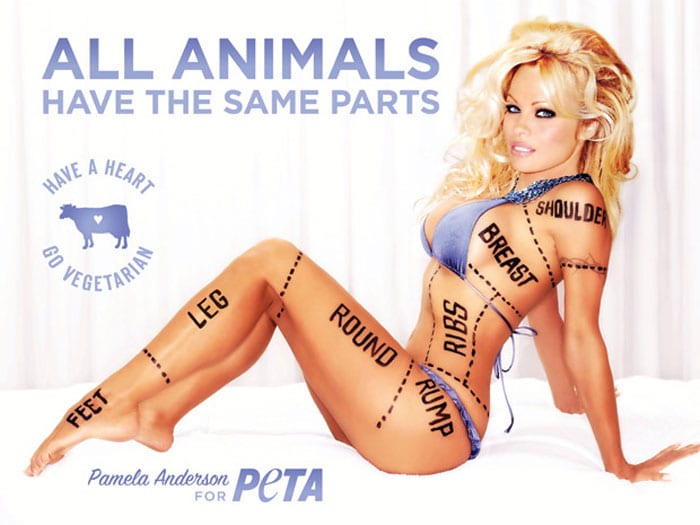
After watching Killing Us Softly in class I thought this advertisement for PETA would be a good one to  talk about in this weeks blog. First of all, PETA is supposed to be this radical animal rights organization known for controversial ways of voicing their beliefs. If this ad isn't controversial I don't know what is. For those who would see this ad and know who Pamela Anderson is, a blonde bombshell, this ad just isn't sending the right message. Instead of saying we shouldn't eat animals they're saying that Pamela Anderson is nothing more than a piece of meat. Going off of the documentary that we watched in class, I believe this advertisement parallels a lot of the ones talked about. Especially the ones where they were objectifying women as sports cars or beer. Here the women in the advertisement is again not human, but an animal. Wearing close to nothing, caked in makeup, and posing in a provocative manner, i'm almost positive that this ad will get the attention of most men. But will it make them stop eating meat? Absolutely not. In fact, it may just have the opposite affect.

Blog Post 9


I always thought advertisement was at least a little sexist, but I had never given it a ton of thought because I thought most of the sexism was over at least a decade ago. However, I was aware that there was a lot of altering of the photos that are put in ads, because women always look perfect. I notice this especially in ads for makeup, because the women always look like they have no flaws on their face. For example, Covergirl always uses a girl that is very wholesome looking and will have mass appeal because she has flawless skin, great makeup, and perfect hair. This isn’t a blatant form of sexism, however it gives girls an unrealistic idea of what they should look like. As I learned from the documentary this causes a lot of issues for girls in their developing years. I never thought about all the consequences that those ads, and other sexist ones, have on girls and women because I tried not to pay too much attention to them. Also, I didn’t realize the impact ads have on violence, I didn’t realize they were that connected as much as they were. This documentary made me realize that most ads out there are pretty sexist, and not just against women, and I definitely have noticed more than before I watched the movie. 

Sunday, March 30, 2014

Post #4 - Holdgrafer


I really enjoyed and loved this assignment. It was a great way to take the class out and about the city, and do a little bit of exploration. I think it was also a good way to keep the class engaged and a little more energized. I went to Prairie Lights, which at first I thought was only a bookstore. When I went in with my group, we walked upstairs to the café area and the first thing I noticed were a lot of people sitting at tables working or being studious. The next thing I noticed was the wood tables, wood floors and natural light coming in the room through a sun window in the ceiling. This brought a lot of a natural and comfortable feel to room without relinquishing the feeling that this was a place to do work or read, not to hang around and gab or gossip, or catch up on life. This is place where it seems that a lot of writers and people with an order of business go to work or to collaborate. The next thing that I noticed upon arriving in the café was the painting on the wall. There was not a uniform or universal theme to these paintings, as some were abstract, some had a dark tone, and some were paintings of sceneries. The coffee bar’s menu was written in chalk and the names were very common names. I think the feeling they want the customers to get is a feeling of ease and simplicity. This notion also does not take away or add too much to the fact that this is an area for your mind to go to work and be productive. Prairie Lights is a great coffee shop, and I definitely recommend everyone to check it out whether it’s to do homework, study or just take sip of a rather well-made latte.

Blog Post 6

Honestly this is the chapter that had the biggest impact on me. After reading and reflecting, I found myself again considering becoming vegetarian. Earlier in life I had come to the thought on my own without the scare tactics involved, but ended up not following through. This time around it was the scare tactics that got me thinking. Although it added to it all as another reason, it wasn’t even the theory of impending microbial doom that got me. In this chapter, I related very strongly to the most graphic, disgusting thing I have ever heard about food. Even typing out the phrase “fecal soup” now makes my stomach turn. When Safran Foer described the process of water-immersion-based chilling, I started making judgments in my head over my eating habits. Chicken has been one of my biggest sources of meat, over my entire life, and I have always eaten a lot of it. Whenever it was prepared for me (whether at a restaurant or at home) it was juicy and salty in taste, and I always preferred it that way. I can’t honestly say that I prefer it that way with a whole heart anymore. I always considered it to be the healthy alternative to red meat. I always considered the juicy, not-breaded, not-fried form to be the healthiest. Now, however, when I think of ‘fecal soup’ I think of the burst of broth juices that comes from a bite into the chicken. I have this sensation even though I know that the chicken I’m eating is completely fine and wholesome. My uncle is an organic farmer, and we’re able to get a lot of really good meat from him. This doesn’t stop my mind from linking the imagery from Eating Animals to eating my food. I’ve curbed my eating habits; stopped eating as much fast food, started eating more vegetables, etc. I find myself eating more hamburger and steak, because cows are the animal that Safran Foer had mentioned the least. My reasoning there is that he seemed to take every single stab that he could at everything that was wrong with the raising and processing of every meat that he could mention. It must, then, be safer to eat beef, right? Thankfully my uncle raises cows and chickens. As a pacifist and conscious mind that considered vegetarianism before, I came into this book knowing that it’d be trying to convince me to convert, and I’ve been resistant. This chapter, however, broke through that. Well played, Safran Foer.

Blog Post 7

One particular moment I found rhetorically effective was during the discussion on the legalization of marijuana. I believe it was Kellen playing the role of an IRS agent who made the point to bring up robberies. This is the first time I had actually heard about this in any debate on the topic. It makes a lot of sense, especially since he brought up the fact that they only deal with cash. Large, concentrated amounts of cash are generally going to attract crime, whether or not drugs are involved at all. It’s the same reason why banks are robbed and why banks have such high security measures. The way I see it now, they are essentially smaller banks with less security that also hold drugs. This seems to me like the perfect target for organized crime. I honestly can’t think of a situation with more reason for a gang or crime organization to rob a place. The other incentive would obviously be competition in the drug market; throwing a legal solution into an already-active drug market could spark violent protest from bigger cartels who refuse to have their profits weaned from them. I hadn’t considered any of this until the group had presented, and I found myself thinking about it outside of class. I hadn’t seen the same argument presented through any of my peers, and I most often (almost 100% of the time, in fact) find people arguing for the legalization rather than people arguing against, or even raising points against. Generally people who are for it are all for it, and those who are against are extremely against it or quiet. For this reason I was anticipating it to be a group of people all speaking for legalization, but was happily surprised to be actually informed on both sides.

Post #6 - Holdgrafer


My favorite chapter in Eating Animals was the chapter that talked mainly about the chickens. I think this one hit home the most because of the way it showed the actual torture going on with the animals. The beginning of the chapter shows an empty rectangle, which is roughly the size of a cage for a grown chicken. Being someone who needs a lot of free open space, I sympathize with the chicken because living in such a cramped area is hard and stressful(depending on whether the chicken likes his neighbors and cagemates, obviously) and takes a toll on the animal, especially when wild chickens are used to running free and being in wide, open spaces (not to be confused with the Dixie Chicks song). I know torture is wrong, and that humane animal slaughter is the best way to do things. When I heard how treacherous these animals have it, I immediately felt awful and disgusted with big companies that do this just to save a few cents per chicken. I also realize that humane slaughter is a lot more critical and time consuming, making factory farming much more economical in the eyes of the greedy, so, although there is a right and ethical way to do things, I feel bad because I feel there is not much I can do. I also thought that Words/Meanings was a good chapter because of all the background information it provided us so that we could further understand different meanings of words by definition and by Saffran Foer’s connotations.